

Poor Hiding Power of Coatings? Don’t Blame Titanium Dioxide Alone – But Choosing the Right Grade Is Critical
Insufficient hiding power of coatings is a persistent headache for many manufacturers. Repeated application, increased material consumption and rising costs directly erode profit margins.
To clarify upfront: many factors affect hiding power. The type of binder, pigment volume concentration (PVC), dispersion process, applied film thickness, substrate colour and smoothness – any flaw in these areas can lead to inadequate hiding. Although titanium dioxide is the key white pigment determining hiding power, it is by no means the only variable.
However, when formulations and processes are reasonably optimised, the quality of titanium dioxide itself becomes the core factor affecting hiding power. Below we focus on analysis of the titanium dioxide component.
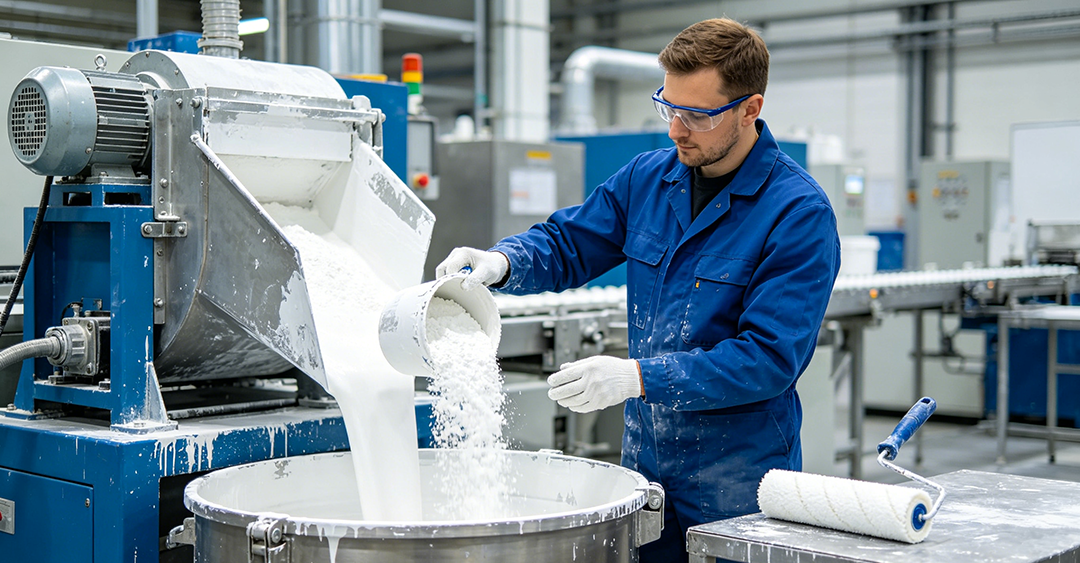
I. How Titanium Dioxide Quality Affects Hiding Power
Insufficient hiding power of titanium dioxide stems from suboptimal performance in several core indicators:
- Poor particle size and distribution Studies show that particle size (especially D50) has the most significant impact on the hiding power of titanium dioxide. Hiding power gradually decreases as D50 increases. Optimal light scattering and maximum hiding efficiency are achieved when titanium dioxide particle size is controlled at 160–350 nm (approximately 0.4–0.5 times the wavelength of visible light). Either oversized or undersized particles weaken this scattering ability. In addition, the width of particle size distribution and the proportion of coarse particles also influence optical efficiency.
- Poor dispersibility Titanium dioxide particles tend to agglomerate. Poor dispersion in the coating system or incomplete encapsulation of particles by the film-forming resin leads to the formation of agglomerates, increasing the effective particle size and reducing hiding power. Meanwhile, poor dispersion states such as flocculation and sedimentation also severely compromise light scattering.
- Low tint reducing power Tint reducing power determines the light absorption and reflection capacity of titanium dioxide. It increases with improved oil-dispersible properties, thereby enhancing hiding power. With insufficient tint reducing power, ideal hiding results may not be attained even with increased titanium dioxide loading.
II. How to Optimise from a Titanium Dioxide Perspective
- Select high-quality grades with precisely controlled particle size The foundation for improved hiding power is adopting advanced production technologies to precisely control titanium dioxide particle size within the optimal scattering range (160–350 nm) and strictly limit the proportion of coarse particles.
- Improve dispersion performance Choose titanium dioxide surface coating types suitable for the coating system (e.g., alumina, silica and other inorganic coatings) to enhance dispersion stability and prevent agglomeration. Meanwhile, use appropriate dispersants to further improve the uniformity of titanium dioxide distribution in coatings.
- Adopt surface coating modification technology Porous and loose inorganic coating treatment on titanium dioxide not only solves chalking caused by photocatalytic activity, but also increases coating porosity, allowing repeated light refraction and significantly enhancing hiding power. Coating treatment is widely recognised as a highly cost-effective performance upgrade solution.
III. Our Recommended High-Performance Rutile Titanium Dioxide
Our products ensure quality from the source – using high-purity titanium raw materials and applying a multi-layer inorganic coating (synergistic silica-alumina-zirconia) for surface modification. The key to this process lies in a dense and uniform coating layer, which greatly improves dispersion stability and increases light scattering paths in the coating through the porous structure, achieving both high hiding power and high dispersibility. Furthermore, precise control of particle size distribution ensures particles fall within the ideal scattering range, guaranteeing hiding performance at the source.
IV. Benefits of Choosing Our Titanium Dioxide
- Excellent hiding power Achieve full hiding with lower loading levels, directly reducing unit formulation costs.
- Outstanding dispersibility Minimise flocculation and agglomeration, simplify grinding processes and improve production efficiency.
- Consistent batch-to-batch quality Continuous production ensures stable performance across batches, avoiding colour differences and fluctuations in hiding power.
- Professional technical support Provide customised formulation optimisation recommendations for your water-based or solvent-based coating systems.
Hiding power is the visible hallmark of coating quality and the underlying foundation of product competitiveness. Choosing the right titanium dioxide resolves the issue effectively. We sincerely invite you to trial our products and welcome in-depth discussions on formulation details with our technical team at any time.
Any disputes shall be subject to actual test results in the specific coating system. If any statement herein is inappropriate, please kindly advise for correction.

