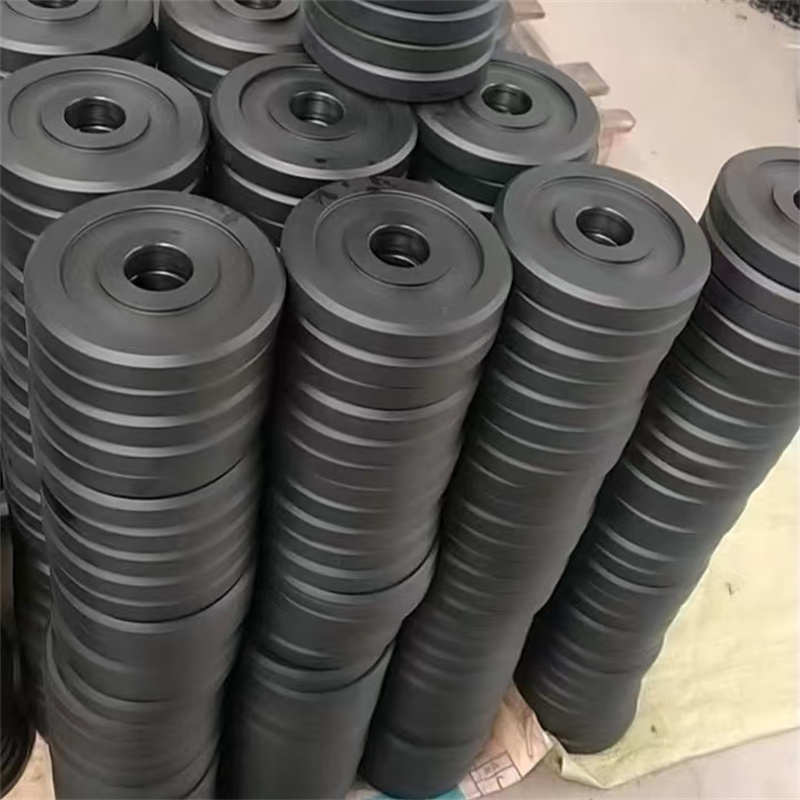
In glass fiber-reinforced flame-retardant nylon systems, barium sulfate functions as a multifunctional inorganic filler that plays a pivotal role in enhancing surface gloss and improving molded aesthetics, while simultaneously maintaining a balanced compromise between mechanical properties and flame retardancy. Its specific contributions are outlined below:
I. Surface Appearance Reconstruction
1.1 Elimination of Glass Fiber Floatation Glass fibers possess a high aspect ratio and orient preferentially along the flow direction during mold filling. Upon cooling, fiber ends protrude from the resin surface, creating micron-scale topographical irregularities that cause diffuse light scattering. In contrast, barium sulfate exhibits an equiaxial granular morphology with no preferred orientation, preventing surface exposure. Furthermore, its fine particles effectively fill micro-depressions in the matrix surface, fundamentally eliminating the fiber floatation defect.
1.2 Enhancement of Gloss and Surface Flatness The dense packing of barium sulfate particles fills microscopic surface voids generated by resin shrinkage, substantially reducing surface roughness. This transformation shifts incident light reflection from diffuse to specular, thereby ensuring a high-gloss finish.

II. Shrinkage Equilibrium Modulation
2.1 Reduction of Shrinkage Anisotropy In glass fiber-reinforced nylon, the linear shrinkage differential between the flow direction and the transverse direction can reach two to threefold. This pronounced anisotropy readily induces warpage and surface sink marks. Leveraging its isotropic granular morphology, barium sulfate reduces the absolute volumetric shrinkage of the system and promotes balanced shrinkage in both longitudinal and transverse directions.
2.2 Suppression of Optical Distortion and Dimensional Deformation Under high-gloss molding conditions with mold temperatures of 100–120°C, balanced shrinkage ensures precise conformance of the molded part to the mold cavity surface. This prevents micro-scale topographical variations and gloss non-uniformity caused by localized mold-part separation, preserving aesthetic consistency.
III. Processing Flowability Optimization
3.1 Reduction of Melt Apparent Viscosity Barium sulfate exhibits excellent dispersibility and effectively reduces melt viscosity in high-melt-index nylon systems. This enhancement improves mold-filling capability, enabling smooth and stable melt progression under “slow–fast–slow” injection profiles.
3.2 Accurate Replication of Mold Surface Finish The improved flowability, combined with adequate venting, ensures complete replication of the mold’s highly polished surface. This eliminates flow hesitation, burn marks, and other defects, achieving high-gloss quality in a single molding cycle.